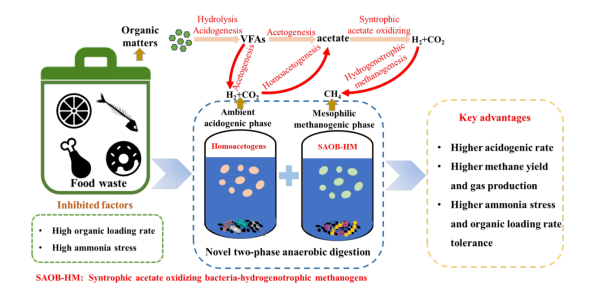
Ammonia inhibition and high organic loading rate (OLR) are major challenges in the anaerobic digestion (AD) of food waste. To address these issues, a novel two-phase AD system was developed, comprising an ambient-temperature acidogenic phase dominated by homoacetogens and a mesophilic methanogenic phase enriched with syntrophic acetate-oxidizing bacteria (SAOB). This configuration was compared with a conventional two-phase AD system. Under an OLR of 7000 mg COD/L, the novel system achieved methane yield and daily gas production that were 232.15% and 338.33% higher, respectively, than those of the control. Acetobacterium, a key homoacetogen, reached a relative abundance of 21.60 % under high OLR, facilitating efficient acetate production. Under ammonia stress, Syntrophobacter and SAOB Thermovirga were significantly enriched in the methanogenic phase, with relative abundances increasing by 9.80% and 8.63%, respectively. PICRUSt analysis further revealed elevated abundances of genes encoding key enzymes: acetate kinase (critical for acetogenesis) and acetyl-CoA decarbonylase/synthase (critical for hydrogenotrophic methanogenesis). These findings demonstrate that the proposed ambient-mesophilic two-phase system significantly enhances process stability and methane production under inhibitory conditions, offering a promising and energy efficient strategy for the treatment of high-organic-strength organic waste. This study proposes a novel temperature-phase separation strategy to reconfigure the metabolic pathways in AD, offering a fundamental solution to overcome ammonia inhibition and high OLR without relying on external additives.