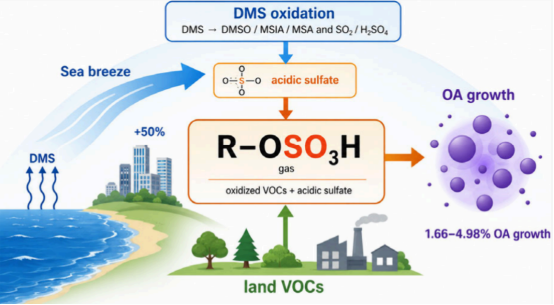
While sea breezes are commonly considered a natural cleansing process for coastal cities, their contribution to marine sulfur chemistry and subsequent organic aerosol formation remains poorly constrained. Using nitrate chemical ionization atmospheric pressure interface time-of-flight mass spectrometry in Xiamen, China, we tentatively assigned 16 gaseous organic sulfur species consistent with organosulfates (OSs) from biogenic and anthropogenic precursor classes. The species showed distinct diurnal patterns, indicating compound-dependent photochemical production and gas−particle exchange. Marine-influenced trajectories were associated with approximately 50% higher summed gaseous OS concentrations than continental trajectories. Random forest models identified methanesulfonic acid, sulfate/sulfuric acid proxies, and photochemical variables as leading predictors, consistent with a coupled marine sulfur−acidic sulfate regime; these associations do not establish direct causality. Volatility calculations placed biogenic OSs preferentially in low- and extremely low-volatility bins. ARCA box model simulations estimated that condensation of the 16 assigned species accounted for 3.32% of modeled organic aerosol growth, with a 1.66−4.98% range from ±50% concentration scaling. These observations suggest that marine sulfur processing can enhance the abundance and partitioning of gaseous organic sulfur species in coastal urban air and provide a measurable pathway linking marine influence to organic aerosol growth.